Friday, April 27, 2012

Synchromism

Synchromism was a Paris-based movement founded in 1912-1913 by American artists, Stanton MacDonald Wright and Morgan Russell. The movement was based on the arrangement of colors in harmonius and musical patterns. The first Synchromist work by Russell - Synchromy in Green, was exhibited at the Salon des Independants in 1913.

    Morgan Russell
Archaic Composition No. 1

Morgan Russell was born in Greenwich Village in New York City in 1886. He studied at the Art Students League and the New York School of Art before settling in Paris in 1909, where he studied sculpture with Henri Matisse. He was aware of the avant-garde movements Cubism, Orphism, and Futurism. Turning his attention from sculpture to painting, he developed a style based on the rhythmic use of color, analogous to symphonic musical composition, which he termed Synchromism. Like his contemporaries Frank Kupka and Robert and Sonia Delaunay, Russell was interested in color theory.

Russell exhibited his Synchromist paintings, along with those of another young American, Stanton Macdonald-Wright, first in Europe and then in New York in 1914 and 1916. Although Russell was discouraged by financial difficulties and abandoned his Synchromist style by 1930, his work had suggested to his American contemporaries the possibilities of a new style of abstract painting that emphasized color. He returned to America in 1946 and died in Broomall, Pennsylvania in 1953.


References:
http://wwar.com/masters/movements/synchromism.html
http://www.moma.org/learn/resources/archives/EAD/Russellf

Section d'Or

Section d’Or, ( French: “Golden Section”) Paris-based association of Cubist painters; the group was active from 1912 to about 1914.

The group’s name was suggested by the painter Jacques Villon, who had developed an interest in the significance of mathematical proportions such as the ancient concept of the golden section, the section d’or. The name thus reflects the Cubist artists’ concern with geometric forms, although Villon and Juan Gris were the only Cubists who directly applied such concepts to their work. The principal members of the group were Robert Delaunay, Marcel Duchamp, Raymond Duchamp-Villon, Albert Gleizes, Juan Gris, Roger de La Fresnaye, Fernand Léger, André Lhote, Louis Marcoussis, Jean Metzinger, Francis Picabia, and André Dunoyer de Segonzac.


Roger de La Fresnaye
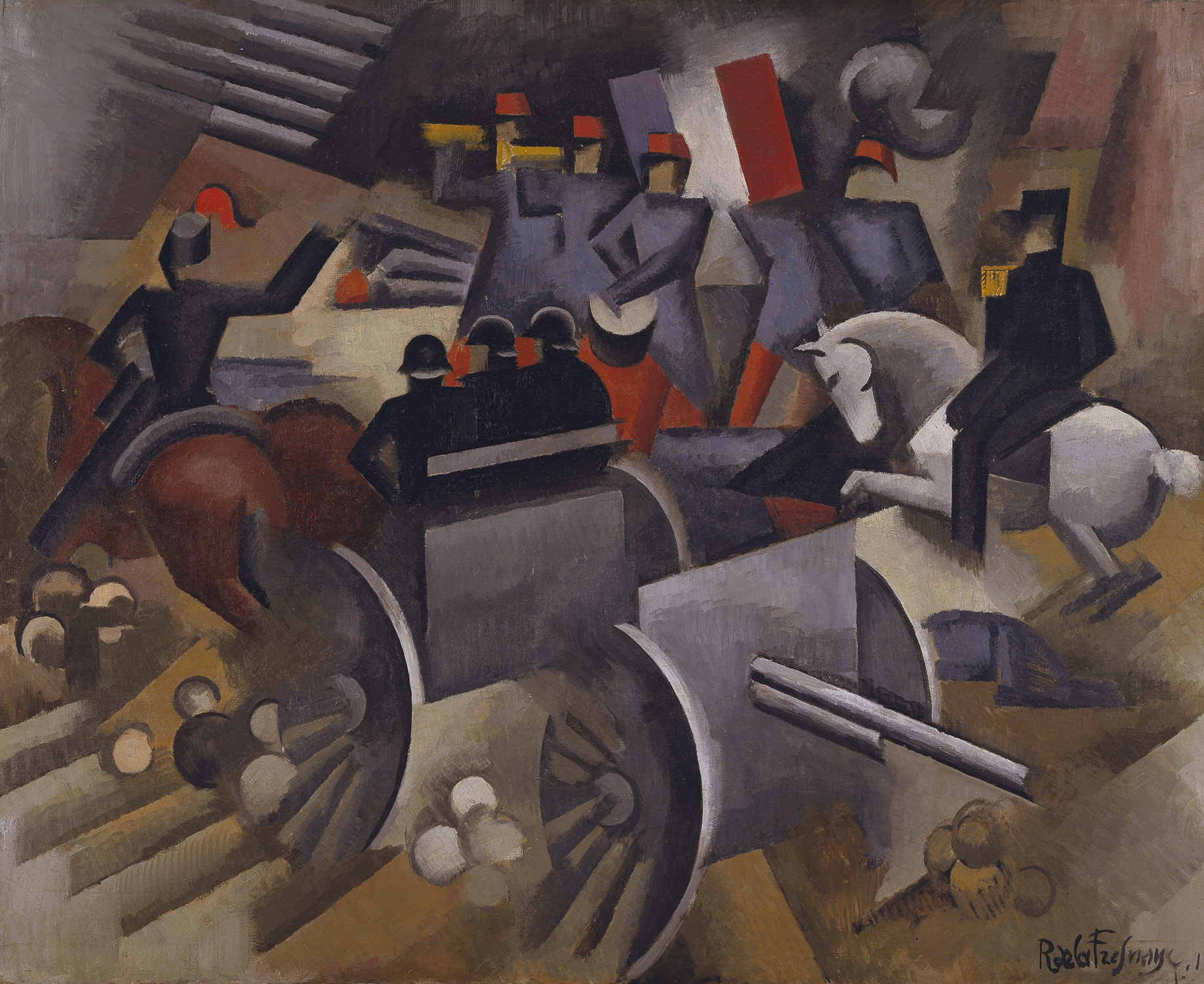
Artillery, 1911

Painted three years before the outbreak of World War I, the subject of this painting appears prophetic. La Fresnaye could often have observed similar military reviews near Les Invalides in Paris. Artillery officers on white and brown horses accompany a caisson (ammunition wagon for moving artillery) that transports a field gun and three soldiers in helmets. In the background a military music band approaches, wearing the blue and red uniforms of the infantry. Although Artillery represents an imaginary scene, La Fresnaye, as the son of a military officer, paid close attention to the various uniforms. Forms are reduced to their utmost simplicity and geometric core, while the color scheme—taking its cue from the tricolore held aloft—is composed of red, white, and blue, along with earthen tones. Painted in 1911, the year he became associated with Cubism and joined the Section d'Or group, Artillery demonstrates the artist's ever greater emphasis on the solid geometry that underlies all forms in nature.

References:
http://www.britannica.com/EBchecked/topic/531974/Section-dOr
http://www.metmuseum.org/toah/works-of-art/1991.397

Der Blaue Reiter

Der Blaue Reiter was formed in 1911 in Munich as a loose association of painters led by Vasily Kandinsky and Franz Marc. They shared an interest in abstracted forms and prismatic colors, which, they felt, had spiritual values that could counteract the corruption and materialism of their age. The flattened perspective and reductive forms of woodcut helped put the artists, especially Kandinsky, on the path toward abstraction in their painting.

The name Blaue Reiter (“blue rider”) refers to a key motif in Kandinsky’s work: the horse and rider, which was for him a symbol for moving beyond realistic representation. The horse was also a prominent subject in Marc’s work, which centered on animals as symbols of rebirth.

Vasily Kandinsky


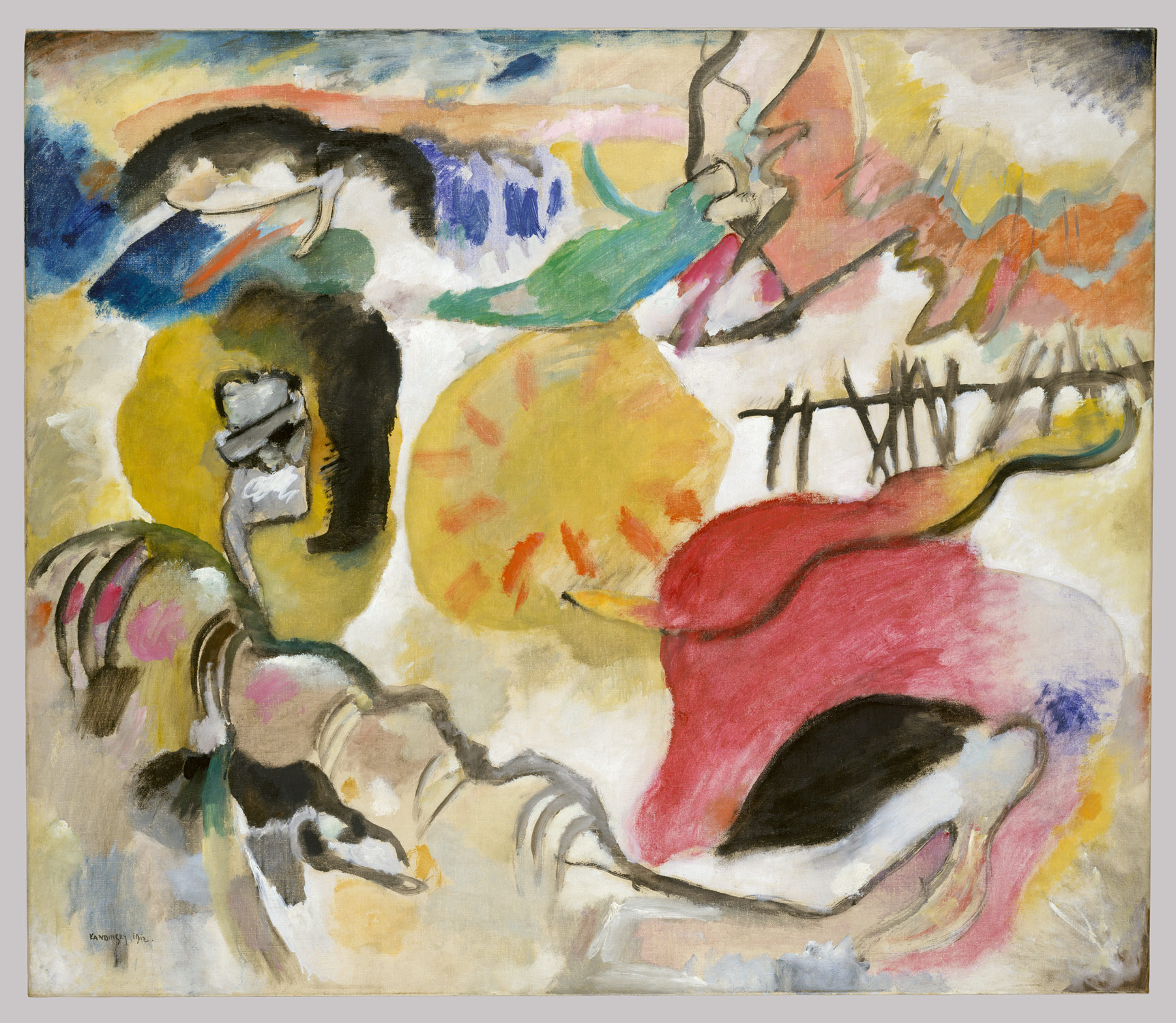
The specific source for the imagery in The Garden of Love is most likely the biblical story of Paradise and the Garden of Eden, one of several Old and New Testament themes addressed by the artist. The imaginary landscape revolves around a large yellow sun in the center of the composition, which pulses with rays of red. The garden is occupied by three abstract pairs of embracing figures: a reclining couple above the sun, another at the lower right, and a third, smaller pair seated at the left. Surrounding them are several animals—certainly a snake and perhaps a grazing horse and sleeping dog. Kandinsky, who was a master watercolorist, successfully achieved a similar effect in this oil painting.

References:
http://www.moma.org/explore/collection/ge/styles/blaue_reiter
http://www.metmuseum.org/toah/works-of-art/49.70.1


Wednesday, April 4, 2012

Futurism

Futurism was primarily concerned with images of speed and motion, which were intended to represent the spirit of the modern age. Although the greatest expression of Futurism is found in the medium of painting, there were some sculptural pieces executed as well, most notably by Umberto Boccioni. Architecture, a later focus for the movement, provided another three-dimensional forum for Futurist ideas about dynamism. The resulting schemes were visionary imaginings that were difficult to translate into actual structures and so remained, for the most part, studies on paper.

Umberto Boccioni
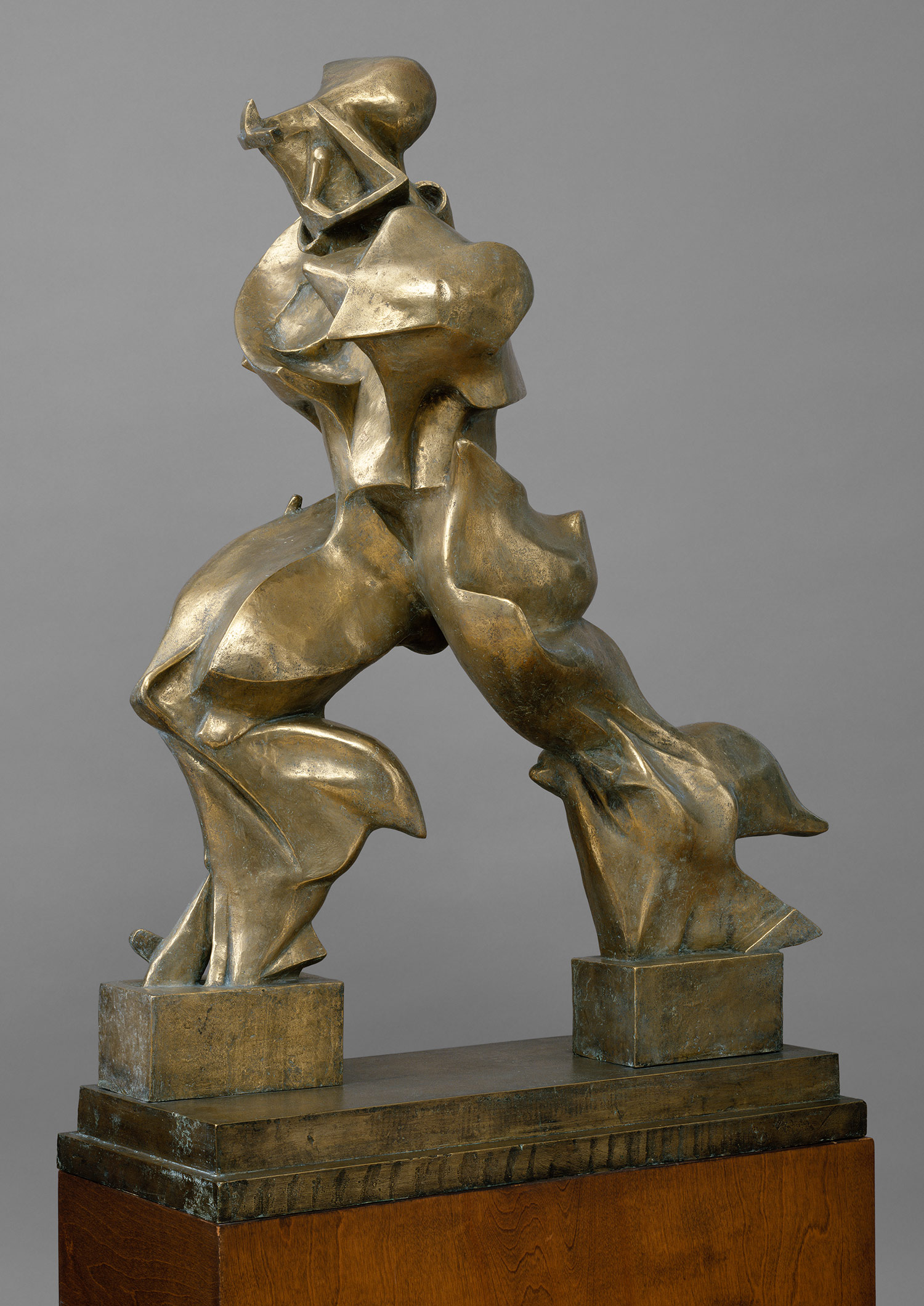
Unique Forms of Continuity in Space

The Italian Futurist Umberto Boccioni had a short but very productive life. He worked primarily as a painter, but also produced drawings, prints, and sculptures that were similarly infused with the energetic movement that symbolized the modern machine age. In 1910 he was one of the signers of the first Manifesto of the Futurist Painters and the Technical Manifesto of Futurist Painting..

Here, in one of Boccioni's few cast pieces, he creates an anonymous superhuman figure striding purposefully through space, but bound to its architectonic base. Considered the most successful of Boccioni's sculptural experiments, this bronze casting was done posthumously in 1949, from the artist's original plaster (which was never cast during his lifetime).

Virgilio Marchi
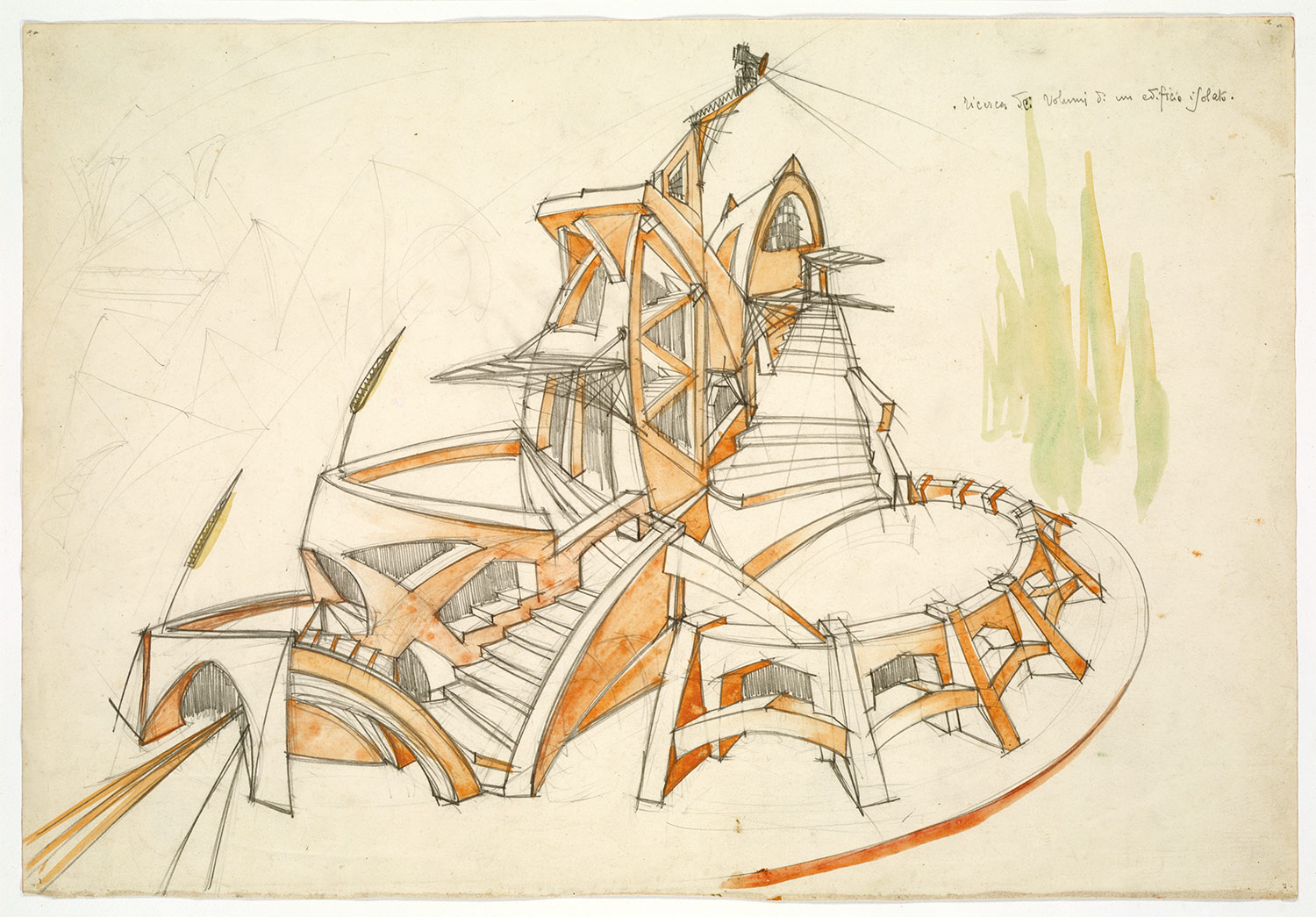
Architectural Study: Search for Volumes in an Isolated Building

In its upwardly spiraling movement, this drawing by Virgilio Marchi typifies Futurist architectural design. It is one of several renderings made by Marchi in 1919 and 1920 for an ideal contemporary city that was never erected. His plans indicated the preoccupation of the period with technological advances in transportation and construction. The building in the present study resembles a cone—round at the bottom, pointed at the top. There are tunneled areas and open archways below, with stairs leading to various flat levels. The two towers that rise from the center are openly constructed with stairs and columns. A spotlight is perched on a beam that extends from the peak of the left tower. The sweeping curves and strong, linear slashes of this beautiful drawing are reminiscent of Giacomo Balla's earlier painted imagery.

References:
http://www.metmuseum.org/toah/works-of-art/1990.38.3
http://www.metmuseum.org/toah/works-of-art/1984.91

Saturday, March 31, 2012

Die Brücke

Die Brücke (The Bridge) was an artistic community of young Expressionist artists in Dresden. Their aim was to overthrow the conservative traditions of German art. Their 'bridge' was a path to a new and better future for German art.The meaning of the name suggested they would build Die Brücke (the bridge) from the great German artistic past of Dürer and Grunewald over the contemporary artistic bourgeoisie to a new and better future. 

Die Brucke made use of a technique that was controlled, intentionally unsophisticated and crude, developing a style hallmarked by expressive distortions and emphases. Die Brucke artists often used color similar to the Fauves, and they were also influenced by art form from Africa and Oceania.
  Some of the painters in the group sympathized with the revolutionary socialism of the day and drew inspiration from Van Gogh's ideas on artists' communities. Die Brucke expressionists believed that their social criticism of the ugliness of modern life could lead to a new and better future. 

The main artistic form that emerged from this fusion of styles was the woodcut. The woodcut had been a traditional German print medium for narrative illustration. When fused with the vocabulary of 'primitive' art, the medium became a powerful tool for personal expression. A modern alterative to this traditional technique was the linocut, a medium invented by Die Brücke.

Karl Schmidt-Rottluff
Karl Schmidt-Rottluff was one of the founding members of the Die Brucke organized in a former butchershop in Dresden in 1905. It was he who named the group after a quote by Nietzsche's Thus Spoke Zarathustra, "What is great in man is that he is a bridge and not an end..."

 Many consider Schmidt-Rottluff to be the most independent of Die Brucke. He was inspired by the expressive power of the art he saw at the Ethnographic Museum in Dresden. Schmidt-Rottluff excelled in the long German tradition of the woodcut.

Karl Schmidt-Rottluff
Madchen aus Kowno (Girl from Kowno)

References:
http://www.artyfactory.com/art_appreciation/art_movements/expressionism.htm
http://www.germanexpressionism.com/printgallery/schmidt-rottluff/index.html

Les Fauves

(Beginning of the 20th century)
Fauvism has its roots in the post-impressionist paintings of Paul Gauguin. It was his use of symbolic colour that pushed art towards the style of Fauvism. Gauguin proposed that colour had a symbolic vocabulary which could be used to visually translate a range of emotions. In 'Vision after the Sermon' where Gauguin depicts Jacob wrestling with an angel, he paints the background a flat red to emphasise the mood and subject of the sermon: Jacob's spiritual battle fought in a blood red field of combat. Gauguin believed that colour had a mystical quality that could express our feelings about a subject rather than simply describe a scene. By breaking the established descriptive role that colour had in painting, he inspired the younger artists of his day to experiment with new possibilities for colour in art.

Les Fauves believed that colour should be used to express the artist's feelings about a subject, rather than simply to describe what it looks like.

Fauvist paintings have two main characteristics: simplified drawing and exaggerated colour. Neo Impressionist painters applied pure colors to their canvases in small strokes. The fauves rejected the impressionist palette of soft, shimmering tones in favor of radical new style, full of violent color and bold distortions.
 

Henri Matisse 
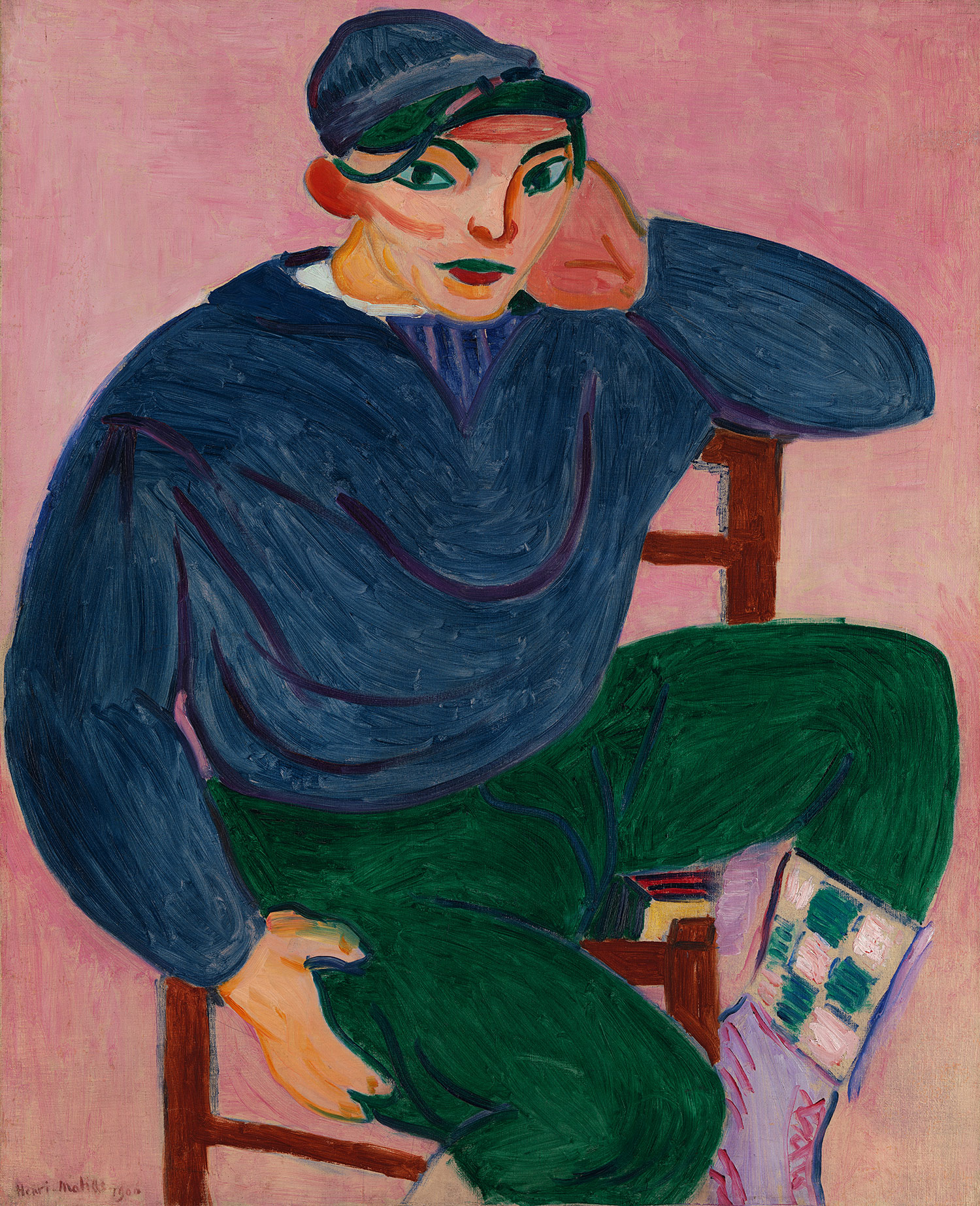
The Young Sailor

Beginning in 1905, Matisse spent the summers—and sometimes even the winters—in Collioure and continued to do so intermittently until about 1914. It was in Collioure that the sitter for The Young Sailor, an eighteen-year-old local fisherman named Germain Augustin Barthélémy Montargès (1888–1938), caught his eye. In this second version of the painting (the first, dated 1906, is in a private collection), the contours have been sharpened, the forms are more defined, and the colors have been reduced to large, mostly flat areas of bright green, blue, and pink—a decorative style and palette adopted by Matisse from this point on. Matisse also drastically altered the sailor's mood and expression. His stylizing brush wiped off the earlier round-cheeked youthfulness of Germain's face, replacing it with a masklike expression of savvy cunning from which a touch of licentiousness seems not absent. Germain's rather theatrical looks and his colorful costume, set against the pink candy-colored ground, combine to make this work one of Matisse's most decorative portraits in the Fauve manner.

References:
http://www.metmuseum.org/toah/works-of-art/1999.363.41
http://www.artyfactory.com/art_appreciation/art_movements/fauvism.htm
http://www.huntfor.com/arthistory/C20th/fauvism.htm

Sunday, March 18, 2012

Expressionism

Expressionism is a term that embraces an early 20th century style of art, music and literature that is charged with an emotional and spiritual vision of the world.

At the end of the 19th century, this Expressionist spirit resurfaced in the paintings of two awkward and isolated personalities – one was the Dutchman, Vincent Van Gogh and the other a Norwegian, Edvard Munch. While the Impressionists were admiring the colour and beauty of the natural landscape, Van Gogh and Munch took a radically different perspective. They chose to look inwards to discover a form of ‘self-expression’ that offered them an individual voice in a world that they perceived as both insecure and hostile. It was this more subjective search for a personal emotional truth that drove them on and ultimately paved the way for the Expressionist art forms of the 20th century that explored the inner landscape of the soul.

Paintings like Van Gogh’s ‘Sunflowers’ (1888) opened our eyes to the intensity of expressive colour. He used colour to express his feelings about a subject, rather than to simply describe it. In a letter to his brother Theo he explained, ‘Instead of trying to reproduce exactly what I see before my eyes, I use colour more arbitrarily to express myself forcibly.’ His heightened vision helped to liberated colour as an emotional instrument in the repertoire of 20th century art and the vitality of his brushwork became a key influence in the development of both the Fauves' and the Expressionists’ painting technique.

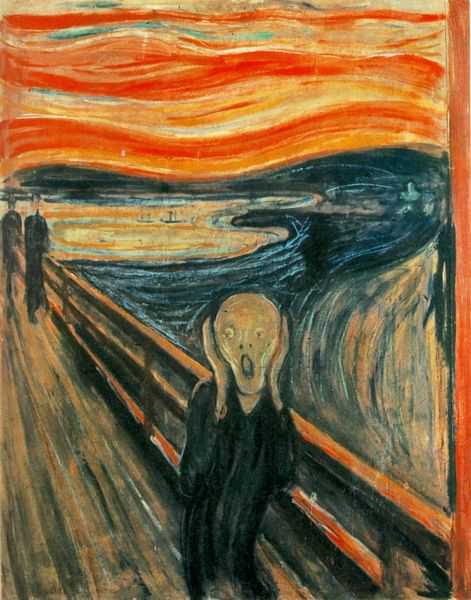
Munch’s painting of ‘The Scream’ (1893) was equally influential. It provides us with a psychological blueprint for Expressionist art: distorted shapes and exaggerated colours that amplify a sense of anxiety and alienation. ‘The Scream’ is Munch’s own voice crying in the wilderness, a prophetic voice that declares the Expressionist message, fifteen years before the term was invented. "I was walking along the road with two friends. The sun set. I felt a tinge of melancholy. Suddenly the sky became a bloody red. I stopped, leaned against the railing, dead tired. And I looked at the flaming clouds that hung like blood and a sword over the blue-black fjord and city. My friends walked on. I stood there, trembling with fright. And I felt a loud, unending scream piercing nature."


Wassily Kandinsky
The Russian-born artist Vasily Kandinsky moved to Munich to study painting in 1896. There, he became one of the founding members of Der Blaue Reiter ("The Blue Rider"), a loose association of artists formed in 1911 to promote a new art, one that would reject the materialist world in favor of the world of emotion and the spirit. 

Referances:
http://www.artyfactory.com/art_appreciation/art_movements/art%20movements/expressionism/van_gogh.jpg
http://www.metmuseum.org/toah/works-of-art/49.70.1